The Father of Geometry – Euclid
 Mathematician: Euclid
Building: Library of Alexandria
Related Mathematical Theories: Prisms and Pyramids
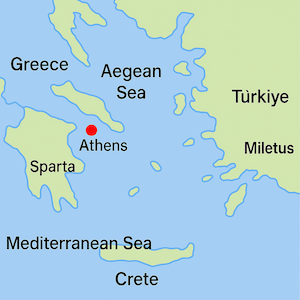
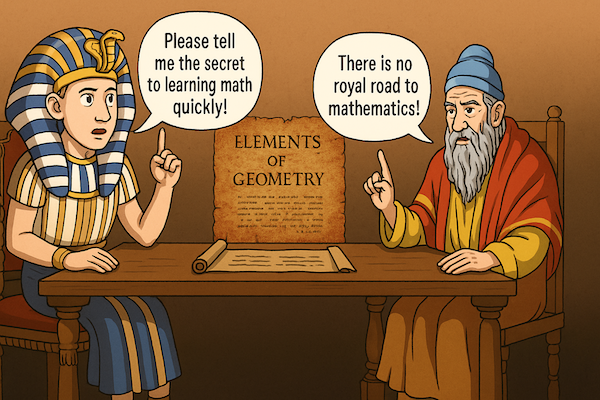
I’m Euclid, often called the “Father of Geometry.” I was born in Athens, Greece, and later became the math teacher to the King of Egypt. One day, the king said to me with a frown: “I am the king! I should be able to learn math faster than common people. Tell me the secret—just for me!”
But I bravely answered, “There is no royal road to learning!”

I wrote a famous book called “The Elements”. It’s the second most well-known book in history, right after the Bible. The final problem in this book is related to dice. It says, “There are only five regular polyhedra in the world.” What does that mean? Don’t worry—I’ll tell you something really cool. (You will learn the full proof when you get to middle school!)
Euclid and the Regular Solids
Euclid was a Greek mathematician who lived around 2,300 years ago and is often called the “Father of Geometry” because he organized and wrote down many important ideas about shapes and spaces in his famous book, Elements
.
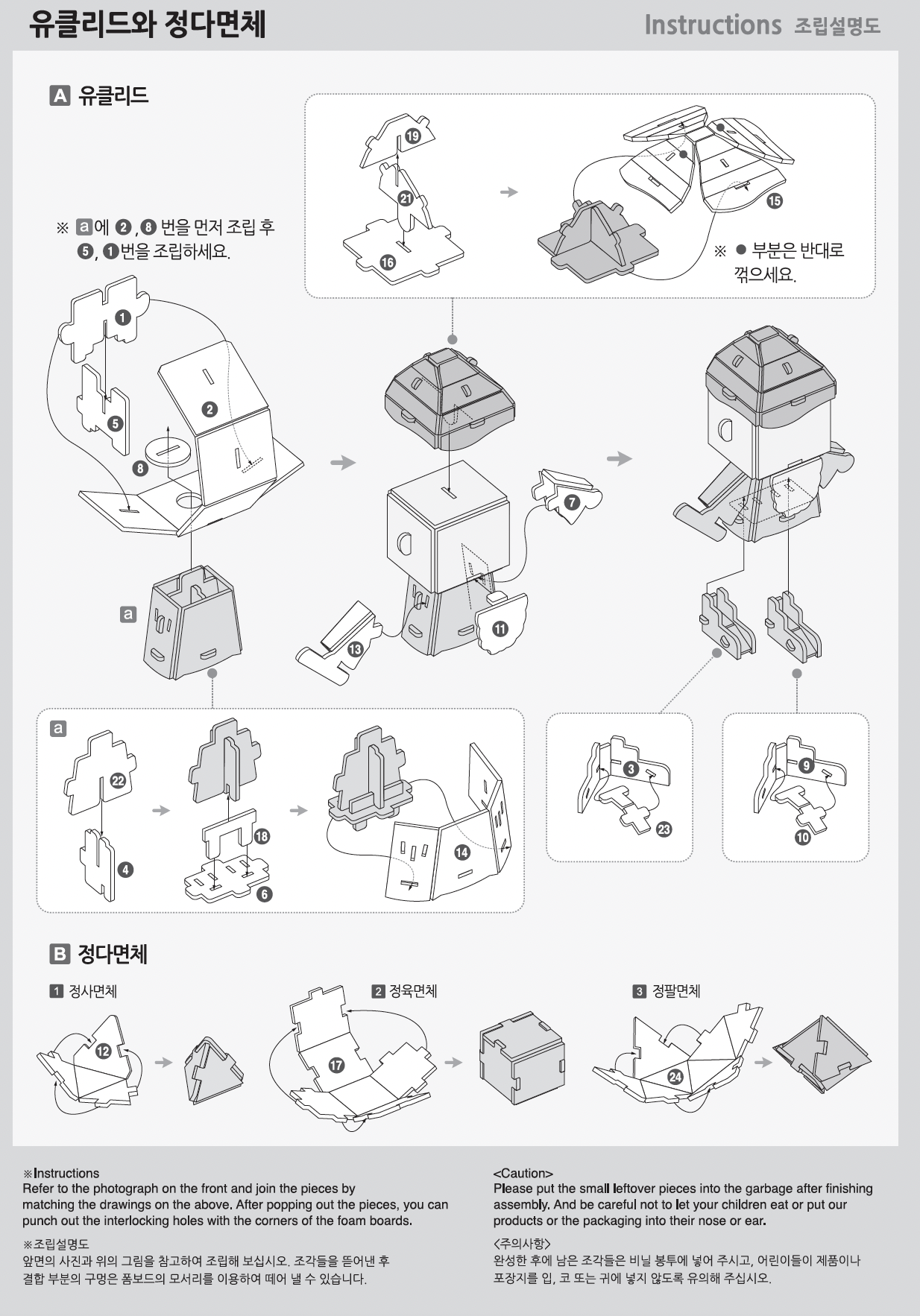
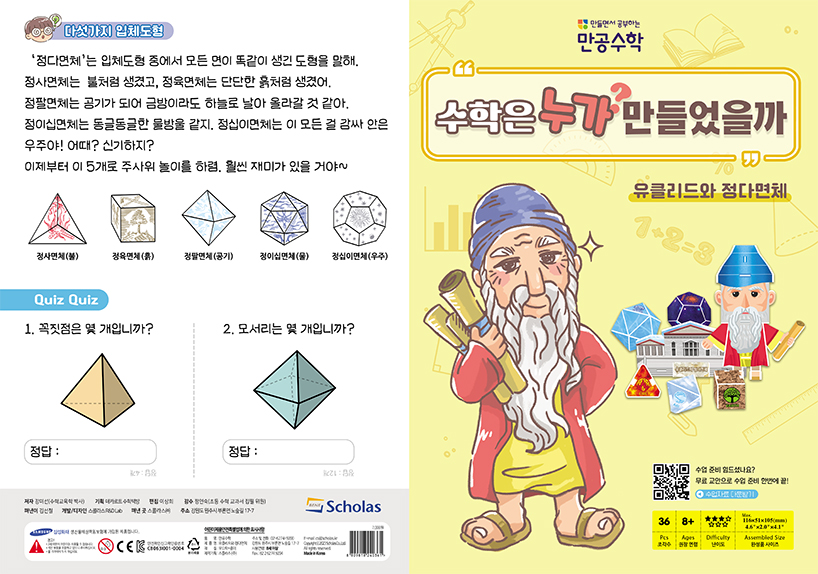
In this book, Euclid described special 3D shapes known as the five regular solids, or Platonic solids. These shapes are unique because each face is the same regular polygon (a shape with equal sides and angles), and the same number of faces meet at each corner. The five Platonic solids are:
Tetrahedron: This shape has 4 triangular faces. It looks like a pyramid with a triangular base.
Cube: Also known as a regular hexahedron, it has 6 square faces. It’s like a regular dice used in games.
Octahedron: This solid has 8 triangular faces. Imagine two pyramids with square bases stuck together at their bases.
Dodecahedron: It consists of 12 pentagonal (five-sided) faces.
Icosahedron: This shape has 20 triangular faces.
These shapes are special because there are only five of them that meet the criteria of having faces with equal sides and angles, and the same number of faces meeting at each vertex
.
Euclid’s study of these solids helped mathematicians understand more about symmetry and structure in three-dimensional space. Today, these shapes are not only important in mathematics but also appear in nature, art, and architecture.
For example, certain crystals and molecules form shapes similar to Platonic solids. In art and architecture, these shapes are appreciated for their beauty and symmetry.
Understanding Euclid’s work and the regular solids gives us a foundation for learning more about geometry and how it describes the world around us.












Reviews
There are no reviews yet.