 Click here to take the quiz!
On September 12, 2016, a 5.8-magnitude earthquake, the strongest ever recorded on the Korean Peninsula, struck Gyeongju. The following year, a 5.4-magnitude earthquake struck Pohang. The earthquakes caused damage such as collapsed walls, tilted buildings, and damaged vehicles. In the past, Korea was considered safe from earthquakes, but recently, earthquakes have become stronger and more frequent. However, historical documents such as “Samguk Sagi”(History of the Three Kingdoms), “Goryeosa”(History of Goryeo), and “Joseon Wangjo Sillok” (Annals of the Joseon Dynasty) indicate that over 1,700 earthquakes have occurred on the Korean Peninsula, making it hard to consider Korea a safe zone from earthquakes.
So, why do earthquakes occur? As shown in the image below, when continuous pressure is applied to the Earth’s crust, it bends. Eventually, when it can no longer withstand the stress, it breaks. This is called a ①  . When a fault forms, vibrations of the ground are transmitted to the surface, and this is called an ② .
 . When a fault forms, vibrations of the ground are transmitted to the surface, and this is called an ② .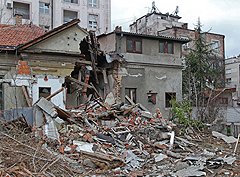
Damage Caused by Earthquakes
Principle of Faults

Earthquakes occur not only along faults but also due to volcanic activity or the collapse of underground caves. Earthquakes can also occur beneath the sea. A ③ is a phenomenon in which sudden changes in sea level, caused by undersea earthquakes, landslides, volcanic eruptions, or meteorite impacts, generate waves that travel long distances. A tsunami is also known as a seismic sea wave. In the deep ocean, tsunami waves are only a few centimeters high, but as they reach shallow waters, they rise dramatically and become dangerous. What should we do if a tsunami occurs? If you feel an earthquake near the sea or notice the water suddenly receding, a tsunami may occur. In such cases, quickly move away from the coast and head to a designated tsunami evacuation area or a sturdy building at least three stories high.
Although modern science and technology cannot predict earthquakes, they can help us prepare for them. By learning earthquake preparedness steps in advance, with earthquake monitoring agencies immediately sending warnings after the first tremor, and by constructing earthquake-resistant buildings, we can prepare for earthquakes.
is a phenomenon in which sudden changes in sea level, caused by undersea earthquakes, landslides, volcanic eruptions, or meteorite impacts, generate waves that travel long distances. A tsunami is also known as a seismic sea wave. In the deep ocean, tsunami waves are only a few centimeters high, but as they reach shallow waters, they rise dramatically and become dangerous. What should we do if a tsunami occurs? If you feel an earthquake near the sea or notice the water suddenly receding, a tsunami may occur. In such cases, quickly move away from the coast and head to a designated tsunami evacuation area or a sturdy building at least three stories high.
Although modern science and technology cannot predict earthquakes, they can help us prepare for them. By learning earthquake preparedness steps in advance, with earthquake monitoring agencies immediately sending warnings after the first tremor, and by constructing earthquake-resistant buildings, we can prepare for earthquakes.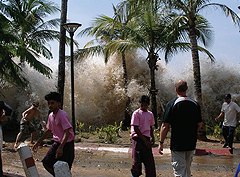
The 2004 tsunami that struck the Indian Ocean coast near Thailand.
Click here to take the quiz!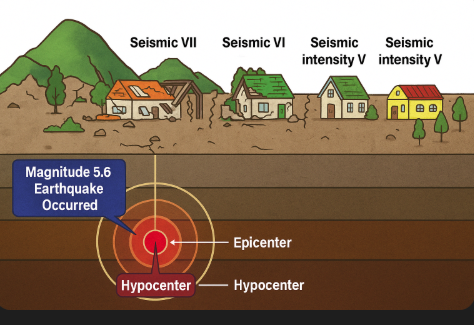
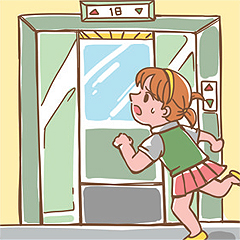
(a) Take the elevator to move
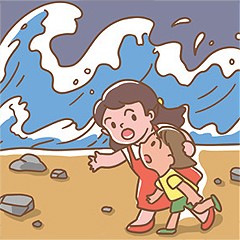
(b) Go to the coast
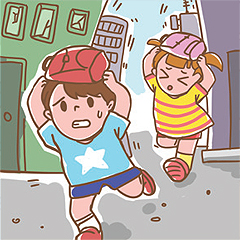
(c) Protect your head with a bag during evacuation.

(d) Take cover under a table when shaking occurs.
Click here to take the quiz!