
 Click here to take the quiz!
Which mountain is the tallest in the entire Korean Peninsula, including both North and South Korea?
The mountain that spans both North Korea and China, ①  is the tallest on the Korean Peninsula, standing at 2,744 meters. South Korea’s highest mountain, ② , located on Jeju Island, reaches 1,947 meters.
Both of these mountains were formed by volcanic eruptions. Baekdusan Mountain, however, is still considered an active volcano. An entry from the “Annals of the Joseon Dynasty” on May 14, 1702, describes its eruption: “Suddenly, the sky and earth became dark, and yellow-red flames and smoke rose. A pungent odor filled the air, and the heat was unbearable, as if sitting in the middle of a furnace. In the morning, the fields were covered with ash that resembled burnt seashells. The ash, about 3 cm deep, was scattered across the fields, leaving behind only charred tree bark.” This vivid description records the eruption of Baekdusan Mountain.
According to historical records, Baekdusan Mountain erupts approximately every 100 years. The most recent eruption occurred in 1903. Now, a century after this eruption, frequent volcanic earthquakes and rising hot spring temperatures indicate an increasing likelihood of a Baekdusan volcanic eruption. Then, how was Baekdusan Mountain formed?
is the tallest on the Korean Peninsula, standing at 2,744 meters. South Korea’s highest mountain, ② , located on Jeju Island, reaches 1,947 meters.
Both of these mountains were formed by volcanic eruptions. Baekdusan Mountain, however, is still considered an active volcano. An entry from the “Annals of the Joseon Dynasty” on May 14, 1702, describes its eruption: “Suddenly, the sky and earth became dark, and yellow-red flames and smoke rose. A pungent odor filled the air, and the heat was unbearable, as if sitting in the middle of a furnace. In the morning, the fields were covered with ash that resembled burnt seashells. The ash, about 3 cm deep, was scattered across the fields, leaving behind only charred tree bark.” This vivid description records the eruption of Baekdusan Mountain.
According to historical records, Baekdusan Mountain erupts approximately every 100 years. The most recent eruption occurred in 1903. Now, a century after this eruption, frequent volcanic earthquakes and rising hot spring temperatures indicate an increasing likelihood of a Baekdusan volcanic eruption. Then, how was Baekdusan Mountain formed?
 is the tallest on the Korean Peninsula, standing at 2,744 meters. South Korea’s highest mountain, ② , located on Jeju Island, reaches 1,947 meters.
Both of these mountains were formed by volcanic eruptions. Baekdusan Mountain, however, is still considered an active volcano. An entry from the “Annals of the Joseon Dynasty” on May 14, 1702, describes its eruption: “Suddenly, the sky and earth became dark, and yellow-red flames and smoke rose. A pungent odor filled the air, and the heat was unbearable, as if sitting in the middle of a furnace. In the morning, the fields were covered with ash that resembled burnt seashells. The ash, about 3 cm deep, was scattered across the fields, leaving behind only charred tree bark.” This vivid description records the eruption of Baekdusan Mountain.
According to historical records, Baekdusan Mountain erupts approximately every 100 years. The most recent eruption occurred in 1903. Now, a century after this eruption, frequent volcanic earthquakes and rising hot spring temperatures indicate an increasing likelihood of a Baekdusan volcanic eruption. Then, how was Baekdusan Mountain formed?
is the tallest on the Korean Peninsula, standing at 2,744 meters. South Korea’s highest mountain, ② , located on Jeju Island, reaches 1,947 meters.
Both of these mountains were formed by volcanic eruptions. Baekdusan Mountain, however, is still considered an active volcano. An entry from the “Annals of the Joseon Dynasty” on May 14, 1702, describes its eruption: “Suddenly, the sky and earth became dark, and yellow-red flames and smoke rose. A pungent odor filled the air, and the heat was unbearable, as if sitting in the middle of a furnace. In the morning, the fields were covered with ash that resembled burnt seashells. The ash, about 3 cm deep, was scattered across the fields, leaving behind only charred tree bark.” This vivid description records the eruption of Baekdusan Mountain.
According to historical records, Baekdusan Mountain erupts approximately every 100 years. The most recent eruption occurred in 1903. Now, a century after this eruption, frequent volcanic earthquakes and rising hot spring temperatures indicate an increasing likelihood of a Baekdusan volcanic eruption. Then, how was Baekdusan Mountain formed?
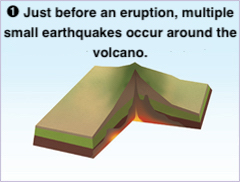
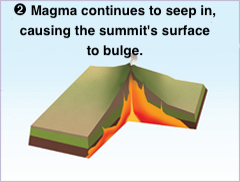
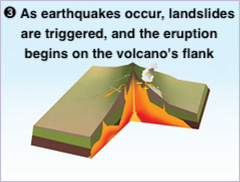
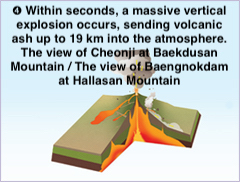
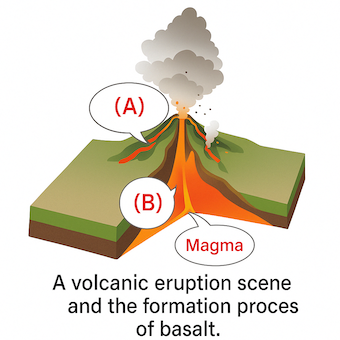
Deep underground, magma rises through weak spots in the Earth’s crust. As magma accumulates and internal pressure increases, the magma eventually erupts, forming a volcano. The eruption releases volcanic ash, rocks, and smoke, which can spread far and wide and cover the surrounding land. Moreover ③
blocks sunlight, lowers temperatures, and inhibits photosynthesizing, making it harder for living organisms to survive.
Baekdusan Mountain formed over a long period, beginning in the early Quaternary period. After a massive volcanic eruption, the top of the crater collapsed, creating a deep hollow called ④ . Rainwater eventually filled this caldera, forming what is now known as ⑤ , the caldera lake.
Although it is impossible to prevent a volcanic eruption, modern scientific technology enables scientists to detect early warning signs, allowing authorities to issue evacuation orders and restrict access to high-risk areas.
blocks sunlight, lowers temperatures, and inhibits photosynthesizing, making it harder for living organisms to survive.
Baekdusan Mountain formed over a long period, beginning in the early Quaternary period. After a massive volcanic eruption, the top of the crater collapsed, creating a deep hollow called ④ . Rainwater eventually filled this caldera, forming what is now known as ⑤ , the caldera lake.
Although it is impossible to prevent a volcanic eruption, modern scientific technology enables scientists to detect early warning signs, allowing authorities to issue evacuation orders and restrict access to high-risk areas.
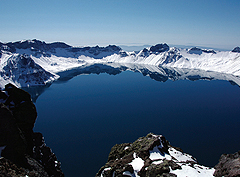
The view of Cheonji at Baekdusan Mountain
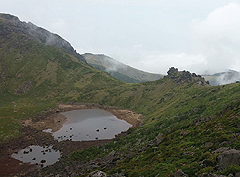
The view of Baengnokdam at Hallasan Mountain
Click here to take the quiz!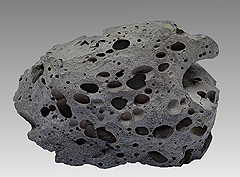
Basalt
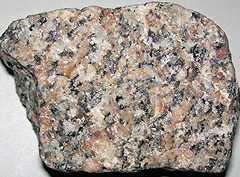
Granite
| Type of Rock | Basalt | Granite |
|---|---|---|
| Grain Size | ⑥ |
⑦ |
| Grain Color | ⑧ |
⑨ |
Inferring the Characteristics of Basalt
Basalt has many holes. Let’s infer why these holes formed by examining rock formation processes (A) and (B). ⑩
(A) Magma deep underground cools slowly, forming rock over time.
(B) Magma reaches the surface, where the temperature is lower than deep underground, and cools quickly to form rock.
| Rock | Characteristics | Tools /Buildings |
|---|---|---|
| Granite | Found throughout South Korea, granite is heat-resistant, durable, and not easily affected by acid rain, making it suitable for building exteriors. It shines when polished. | ⑪ |
| Basalt | This rock is found in regions with developed lava plateaus, such as Cheorwon and Jeju Island in South Korea. It is hard and heat-resistant. | ⑫ |
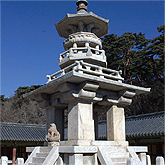
(a) Dabotap Pagoda
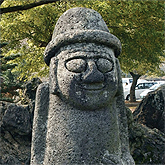
(b) Dolharubang

(c) Curling Stone
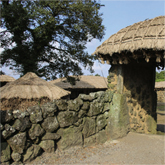
(d) Jeju Stone Walls
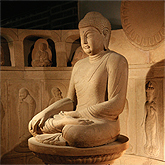
(e) Seokguram Grotto
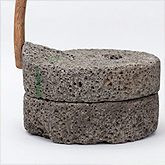
(f) Millstone
Click here to take the quiz!| (a)Baekdusan Mountain | Features |
|---|---|
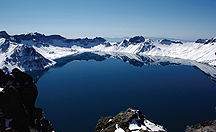 | The summit is hollowed out, and there is a lake at the top. |
| (b)Geumgang Mountain | Features |
|---|---|
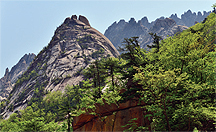 |
⑬ |
| (c)Seonginbong & Nari Basin, Ulleungdo / Features | Features |
|---|---|
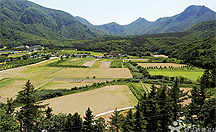 |
⑭ |
| (d)Bukhansan Mountain | Features |
|---|---|
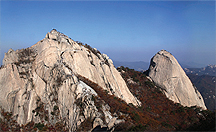 |
⑮
|
| (e)Seoraksan Mountain | Features |
|---|---|
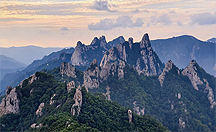 |
⑯ |
| (f)Hallasan Mountain | Features |
|---|---|
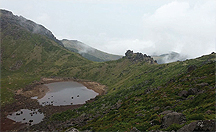 |
⑰ |
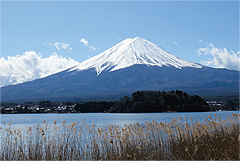
(a)Mount Fuji, Japan
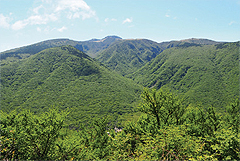
(b)Hallasan Mountain, South Korea
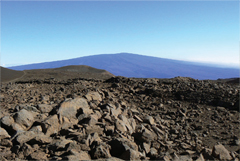
(c)Mauna Loa, Hawaii, USA
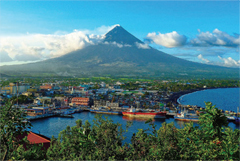
(d)Mayon Volcano, Philippines