
 Click here to take the quiz!
What is the difference between Earth and other celestial bodies (planets, moons, etc.) in the solar system?
①  is the only planet in the solar system where life exists. Life on Earth is possible because it has air and ② . Earth is the only planet in the solar system where liquid water can be found. When Earth is photographed from space, its color is different because of the water. About 70% of Earth’s surface is covered by the ③ , which looks blue.
 is the only planet in the solar system where life exists. Life on Earth is possible because it has air and ② . Earth is the only planet in the solar system where liquid water can be found. When Earth is photographed from space, its color is different because of the water. About 70% of Earth’s surface is covered by the ③ , which looks blue.
Grasslands and forests appear green, deserts look yellow, and areas with glaciers or clouds appear white.
However, due to pollution, the amount of water available to living organisms is decreasing. This has made scientists interested in other celestial bodies, as they believe that if they find water, life could exist there too. Currently, they are sending probes to other planets and moons to check if water exists.
The planet ④ is close to Earth and has a similar size, a solid crust, ice, and signs of flowing water, making it one of the most likely planets to support human life. Scientists have sent Mars rovers several times to search for water and signs of life. In December 2021, they found evidence that there could be a large amount of water in Mars’ Marineris Canyon. If water is confirmed, humans may one day build a base on Mars.
⑤ as the most likely place for life in the solar system. Beneath Europa’s icy surface, there is likely an ocean, and its composition is thought to be similar to that of Earth. NASA launched the Europa Clipper spacecraft on October 14, 2024. It is expected to arrive in Jupiter’s orbit in 2030 to explore whether life could exist on Europa.
is close to Earth and has a similar size, a solid crust, ice, and signs of flowing water, making it one of the most likely planets to support human life. Scientists have sent Mars rovers several times to search for water and signs of life. In December 2021, they found evidence that there could be a large amount of water in Mars’ Marineris Canyon. If water is confirmed, humans may one day build a base on Mars.
⑤ as the most likely place for life in the solar system. Beneath Europa’s icy surface, there is likely an ocean, and its composition is thought to be similar to that of Earth. NASA launched the Europa Clipper spacecraft on October 14, 2024. It is expected to arrive in Jupiter’s orbit in 2030 to explore whether life could exist on Europa.
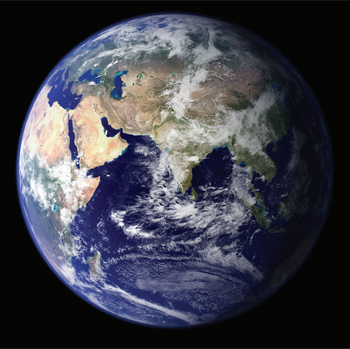
Earth seen from Space
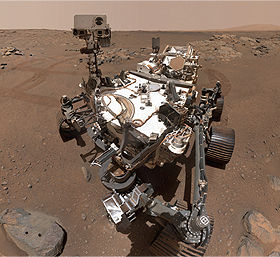
The Mars rover Perseverance
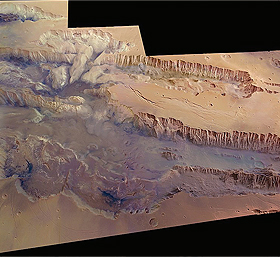
Valles Marineris on Mars
Photo courtesy : European Space Agency, Wikimedia Commons
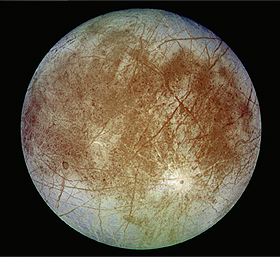
Europa, one of Jupiter’s moons
Click here to take the quiz!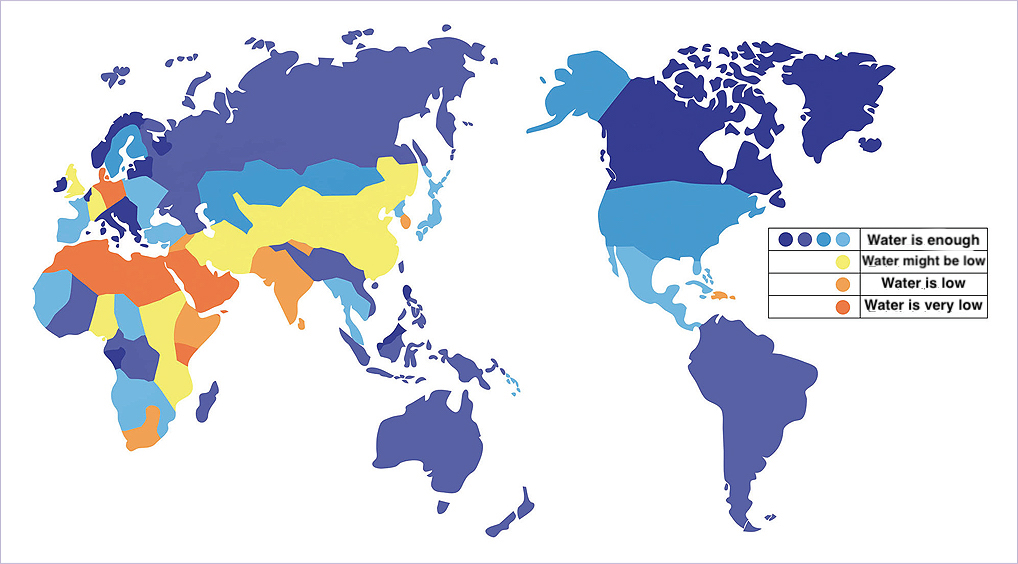
Water Shortage Status Map
Brazil in South America has ⑥ water, and South Korea has ⑦ water. Northern Africa and Southwest Asia are places that also have. ⑧ water.
water, and South Korea has ⑦ water. Northern Africa and Southwest Asia are places that also have. ⑧ water.Think About Why the Sahara Desert Is Expanding
A desert is usually a place that gets less than 100mm of rain each year. The largest desert in the world is the Sahara Desert in northern Africa. It has been getting bigger every year, and over the last 100 years, it has grown as large as the United States. Scientists say the Sahara is growing because the temperature in the region has steadily ⑨over the past century. This makes more water evaporate and makes the land even drier.
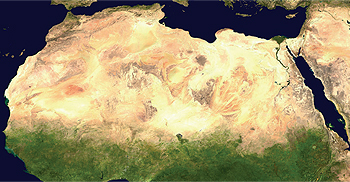
Sahara Desert (Yellow Part)
Finding Ways to Solve the Water Shortage
Water shortages happen when the population grows, industries develop, and people use more water. Also, when water gets badly polluted, there is less clean water for us to use. Look at the picture below and find some ways we can help solve the water shortage problem. ⑩
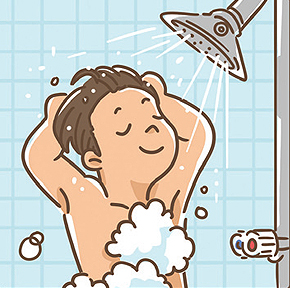
① Taking long showers

② Doing laundry all at once
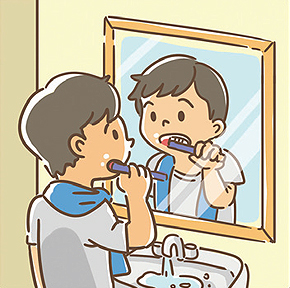
③ Brushing your teeth with the water running

④ Washing dishes using a basin of water
Click here to take the quiz!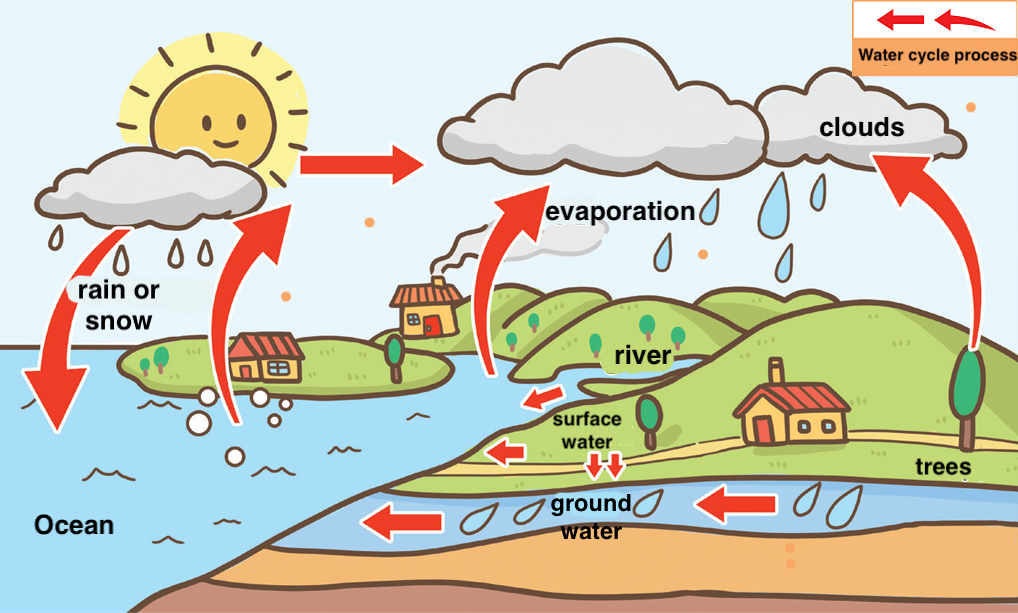
When the sun shines, the temperature goes up. Water from lakes, rivers, and oceans evaporates and becomes gas called ⑪ . As the air cools down, the vapor turns into tiny water droplets and forms ⑫ . When the water droplets or ice in the clouds get bigger, they fall to the ground as rain or snow. Rainwater flows into streams and rivers or soaks into the ground to become ⑬ . Water from rivers, streams, and underground flows gathers in the ocean. Trees take in water from the ground through their ⑭ and release some of it through their ⑮ .
Water keeps moving all the time and never stays in one place.
. As the air cools down, the vapor turns into tiny water droplets and forms ⑫ . When the water droplets or ice in the clouds get bigger, they fall to the ground as rain or snow. Rainwater flows into streams and rivers or soaks into the ground to become ⑬ . Water from rivers, streams, and underground flows gathers in the ocean. Trees take in water from the ground through their ⑭ and release some of it through their ⑮ .
Water keeps moving all the time and never stays in one place.
Activity 3: Understanding how the waka water device collects water using the water cycle.
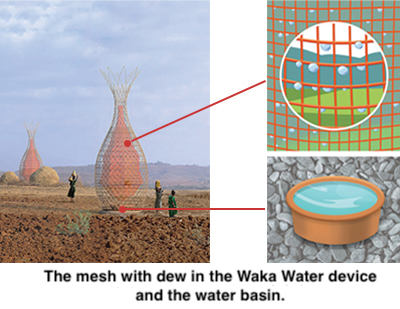
Waka Water is a device that collects water in places where water is hard to find. During the day, the heat makes water evaporate and turn into vapor. At night, when the air cools down, the vapor changes back into water and forms droplets on a net-like surface. When many droplets gather, they get heavy and drip down to the bottom. This is a great way to get clean drinking water in dry areas. But this device doesn’t work everywhere. Where can it be used? It works only in places with a ⑯
temperature difference between day and night. If the temperature difference is small, water droplets do not form well, so water cannot be collected.
The mesh with dew in the Waka Water device and the water basin.