
 Click here to take the quiz!
Have you ever played “Für Elise” on the piano? Or have you listened to the powerful “Symphony No. 5 (Fate)” performed by an orchestra? The music I composed is still often used today in commercials, movies, and TV shows. I was born in 1770 in Bonn, Germany. My father taught me music and made me perform piano concerts when I was young—just like Mozart, who was a famous child music genius. I became popular for my piano improvisations, where I made up music and played it right away on stage.
However, when I was about 26, I started to lose my hearing because of an illness. By the time I was 30, I could hardly hear anything. At 49, I lost my hearing completely. Because I could no longer hear well, I used a hearing aid or wrote on paper to talk with people. I also felt the ①  of music by touching instruments or placing my hands or body on them. Since it became hard for me to perform or conduct music, I focused more on composing music instead. Even after I became deaf, I composed famous symphonies like “Eroica (Heroic)”, “Fate”, “Pastoral”, and “Ode to Joy”. When “Ode to Joy” was performed for the first time, the audience clapped loudly and cheered, but I didn’t realize it. Someone had to turn me around so I could see the people clapping. Even though I couldn’t hear, I composed many beautiful songs. Because of this, people call me the “Saint of Music.” or a “Great Musician.”
In 1977, the Voyager 1 and 2 spacecraft were launched with a Golden Record. On that record, they included my music — the first movement of Symphony No. 5 (“Fate”) and the fifth movement of String Quartet No. 13 (“Cavatina”). This music was sent into space so that any alien life that might find the spacecraft could listen to it. Who am I? ②
of music by touching instruments or placing my hands or body on them. Since it became hard for me to perform or conduct music, I focused more on composing music instead. Even after I became deaf, I composed famous symphonies like “Eroica (Heroic)”, “Fate”, “Pastoral”, and “Ode to Joy”. When “Ode to Joy” was performed for the first time, the audience clapped loudly and cheered, but I didn’t realize it. Someone had to turn me around so I could see the people clapping. Even though I couldn’t hear, I composed many beautiful songs. Because of this, people call me the “Saint of Music.” or a “Great Musician.”
In 1977, the Voyager 1 and 2 spacecraft were launched with a Golden Record. On that record, they included my music — the first movement of Symphony No. 5 (“Fate”) and the fifth movement of String Quartet No. 13 (“Cavatina”). This music was sent into space so that any alien life that might find the spacecraft could listen to it. Who am I? ②
 of music by touching instruments or placing my hands or body on them. Since it became hard for me to perform or conduct music, I focused more on composing music instead. Even after I became deaf, I composed famous symphonies like “Eroica (Heroic)”, “Fate”, “Pastoral”, and “Ode to Joy”. When “Ode to Joy” was performed for the first time, the audience clapped loudly and cheered, but I didn’t realize it. Someone had to turn me around so I could see the people clapping. Even though I couldn’t hear, I composed many beautiful songs. Because of this, people call me the “Saint of Music.” or a “Great Musician.”
In 1977, the Voyager 1 and 2 spacecraft were launched with a Golden Record. On that record, they included my music — the first movement of Symphony No. 5 (“Fate”) and the fifth movement of String Quartet No. 13 (“Cavatina”). This music was sent into space so that any alien life that might find the spacecraft could listen to it. Who am I? ②
of music by touching instruments or placing my hands or body on them. Since it became hard for me to perform or conduct music, I focused more on composing music instead. Even after I became deaf, I composed famous symphonies like “Eroica (Heroic)”, “Fate”, “Pastoral”, and “Ode to Joy”. When “Ode to Joy” was performed for the first time, the audience clapped loudly and cheered, but I didn’t realize it. Someone had to turn me around so I could see the people clapping. Even though I couldn’t hear, I composed many beautiful songs. Because of this, people call me the “Saint of Music.” or a “Great Musician.”
In 1977, the Voyager 1 and 2 spacecraft were launched with a Golden Record. On that record, they included my music — the first movement of Symphony No. 5 (“Fate”) and the fifth movement of String Quartet No. 13 (“Cavatina”). This music was sent into space so that any alien life that might find the spacecraft could listen to it. Who am I? ②
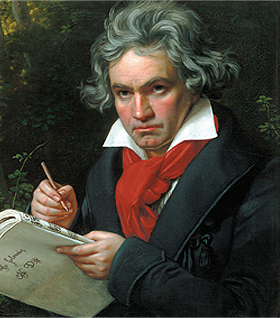
Ludwig van Beethoven (1770~1827)
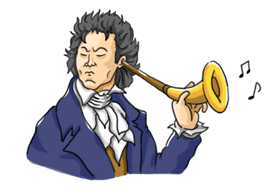
Beethoven using a hearing aid to listen
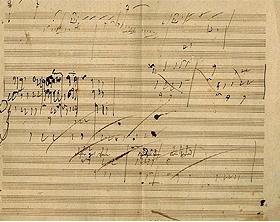
Beethoven’s handwritten music sheet
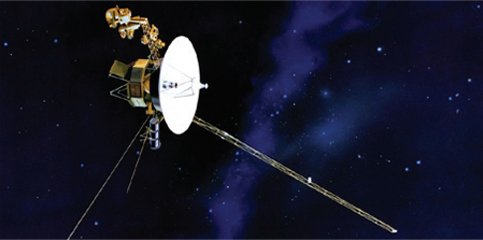
Voyager 1 spacecraft
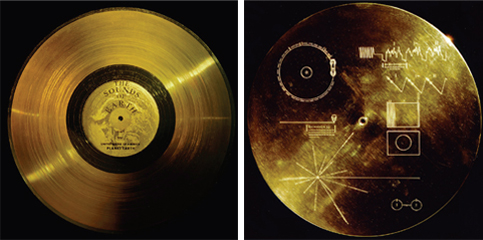
Golden Record sent on Voyager 1 and
Click here to take the quiz!- (1) ) If you put your hand on your neck and say “ah”, your neck will ③ . If you don’t make a sound, your neck ④ .
- (2) Tap a cup that is half-filled with water. When you tap the cup, the water ⑤ . If you don’t tap it, the water ⑥ . If you tap it hard, the water vibrates ⑦ .
- (3) Put your ear on the desk and tap the end of it. The sound ⑧ . ). If you tap it softly, the sound is ⑨ . If you tap it harder, the sound is ⑩ .
Sound is created when an object ⑪ , and there must be something (a material) to carry the sound.
, and there must be something (a material) to carry the sound.When vibration is big, the sound is ⑫ . ). When the vibration is small, the sound is ⑬ .
. ). When the vibration is small, the sound is ⑬ .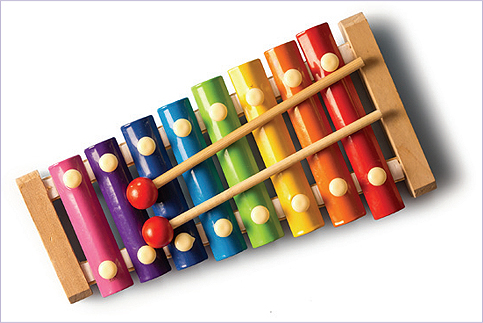
xylophone
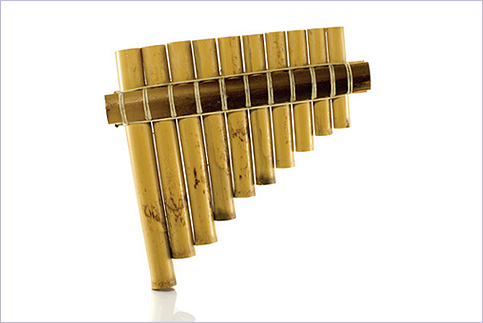
pan flute
- (1) Tap the bars on a xylophone in order from the longest to the shortest and compare the sounds. If you don’t have a xylophone, watch a video of a xylophone performance. When you tap the long bar, it makes a ⑭ sound, and the short bar makes a ⑮ sound.
- (2) Blow through the pipes of a pan flute from the longest to the shortest and compare the sounds.If you don’t have a pan flute, try blowing through long and short plastic pipes or watch a video of a pan flute performance.
When you blow through the long pipe, it makes a ⑯ sound, and the short pipe makes a ⑰ sound.
Click here to take the quiz!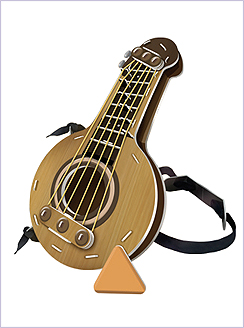
➊ Pluck the string from the shortest to the longest on the stand and listen carefully to the pitch of each sound.
● The shorter string makes a ⑲ sound, and the longer string makes a ⑳ sound.
 sound, and the longer string makes a ⑳ sound.
➋ Vary the strength when plucking the string and listen carefully to the volume of the sound.
● A stronger pluck makes a ㉑ sound, and a softer pluck makes a ㉒ sound.
sound, and a softer pluck makes a ㉒ sound.
➌
Press the string to make it tight and pluck it to hear the pitch. Then release the string to make it loose and pluck it again.
● A tight string makes a ㉓ sound, and a loose string makes a ㉔
sound.
sound, and a loose string makes a ㉔
sound.
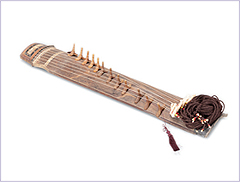
(a) Gayageum
Photo courtesy: National Folk Museum of Korea
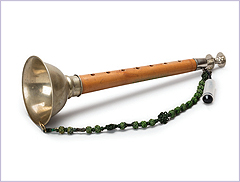
(b) Taepyeongso
Photo courtesy: National Folk Museum of Korea
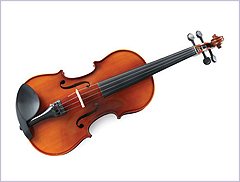
(c) Violin
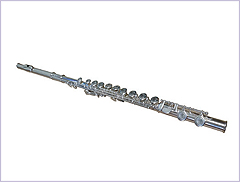
(d) Flute
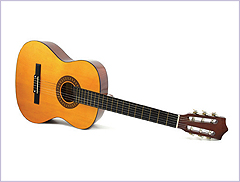
(e) Guitar
Photo courtesy: National Folk Museum of Korea
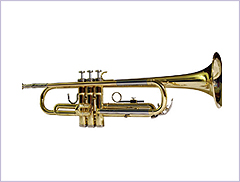
(f) Trumpet
Photo courtesy: Amada44, Wikimedia Commons
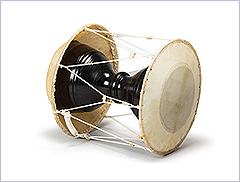
(g) Janggu
Photo courtesy: National Folk Museum of Korea
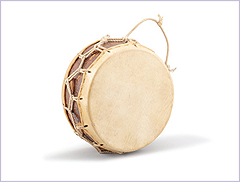
(i) Buk Photo provided by the National Folk Museum of Korea