
 Click here to take the quiz!
I was born on May 23, 1707, in Stenbrohult, Sweden. My father was a pastor and also an amateur botanist. He grew many kinds of flowers in our garden. He loved spending time with me and teaching me the names and parts of the flowers. Because of this, I became very interested in plants and really enjoyed observing them. At first, I studied religion to become a pastor like my father. But one of my teachers saw that I was very curious about plants, so he encouraged me to study pharmacy. Plants are used to make medicine, so knowing a lot about plants helped me in my pharmacy studies. Later, I studied medicine at Uppsala University. The university had a big garden full of plants, and I could study the plants I loved even more. Because I knew so much about plants, my professors asked me to teach botany—even though I was still a student!
In 1735, I wrote a very famous book called “Systema Naturae”. At first, it was only 14 pages long, but I kept adding more to it. By the time I finished, it had 2,300 pages! In this book, I divided natural into three groups: animals, plants, and minerals. I sorted animals into 6 groups and plants into 24 groups, based on their special features. My system became the basis for how we name and group living things today. I was the first person to create a naming system for all living things, called the ①  .
.
Scientists all around the world use these names so they can clearly understand which living thing they are talking about. The system uses two names: the ② name and the ③ name.
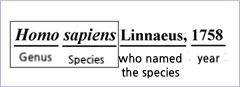
For example, the scientific name for humans is Homo sapiens. ‘Homo’ is the genus name and ‘sapiens’ is the species name. In this system, the genus and species names are written in Latin and italicized. The first letter of the genus is capitalized, while the rest are lowercase. This naming system is used globally, and the name of the person who named the species is often added, usually written as Linnaeus, my Latinized name.
If you discover living thing and give it a name, your name could appear as the person who named it! Known as the Father of Taxonomy and the Prince of Botany, who am I? ④
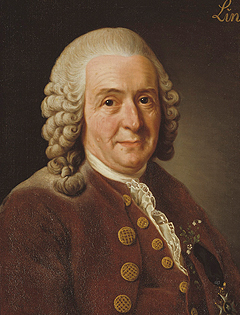
Carl von Linne (1707~1778)
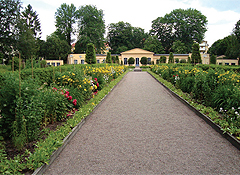
Linnaeus Garden (Uppsala University)
Image Courtesy: Calle Eklund / V-wolf
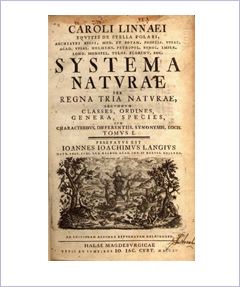
Systema Naturae
 Click here to take the quiz!
Observing Leaf Structure
Most tree leaves are made up of the ⑤ , ⑥ , and stipules. The leaf blade is green because it has chloroplasts. It helps the plant make food by using sunlight. On the back of the leaf blade, there are tiny holes called stomata that let gases move in and out. The ⑦ carry water and nutrients and help the leaf keep its shape. The ⑧ connects the leaf to the stem and moves the leaf so it can get more sunlight. Stipules are tiny leaves under the leaf stalk. They protect the young leaf when it is growing.
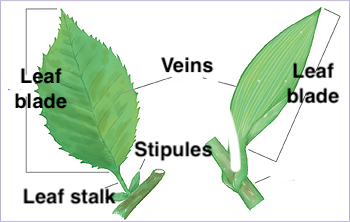
Leaf Structure
| Name | ⑨ |
⑩ |
⑪ |
⑫ |
⑬ |
|---|---|---|---|---|---|
| Leaf Shape | 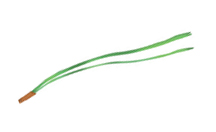 |
 |
 |
 |
 |
| features | The leaf has a ⑭  , needle-like tip. Two leaves grow together in the same spot. , needle-like tip. Two leaves grow together in the same spot. |
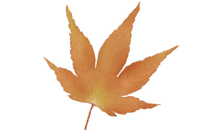
The leaf is palm-shaped and deeply divided. The tip of the leaf is pointed, and the edge is ⑮ . |
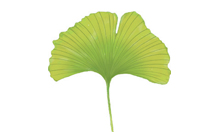
The leaf is shaped like a ⑯ , and the edges are wavy. |
The leaf is long, with ⑰
veins, and its edges have tiny hairs. |
The leaf grows in clusters of three. The leaf tips are round, and the edges have a ⑱
shape. |
| Name |
|---|
| ⑨ |
| Leaf Shape |
|
features |
| The leaf has a ⑭ , needle-like tip. Two leaves grow together in the same spot. |
| Name |
| ⑩ |
| Leaf Shape |
|
| features |
| The leaf is palm-shaped and deeply divided. The tip of the leaf is pointed, and the edge is (⑮ . |
| Name |
| ⑪ |
| Leaf Shape |
|
| features |
| The leaf is shaped like a ⑯ , and the edges are wavy. |
| Name |
| ⑫ |
| Leaf Shape |
|
| features |
| The leaf is long, with ⑰ veins, and its edges have tiny hairs. |
| Name |
| ⑬ |
| Leaf Shape |
|
| features |
| The leaf grows in clusters of three. The leaf tips are round, and the edges have a ⑱ shape. . |
Click here to take the quiz!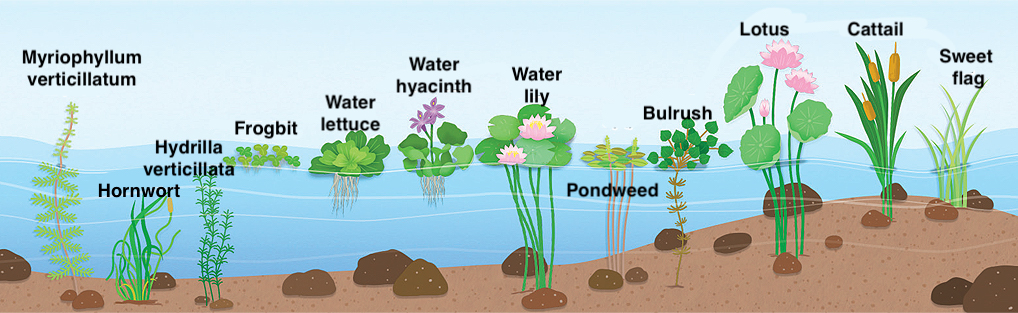
Classification Criteria: ㉒ 
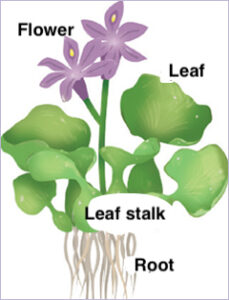
Water Hyacinth Structure
on the cut surface of the leaf stalk.
[Experiment 2]
Place the leaf stalk in a water-filled tank and gently press it with your finger. → ㉔ will be released from the leaf stalk and rise upwards.
⇨ The reason water hyacinth can float on water is due to the ㉕ in the leaf stalk, which contains air pockets.
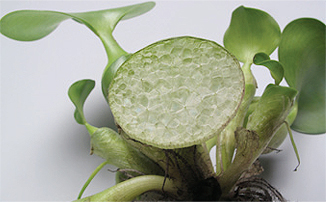
A cross-section of the water hyacinth (cut horizontally)
Photo Courtesy: Yonhap News Agency
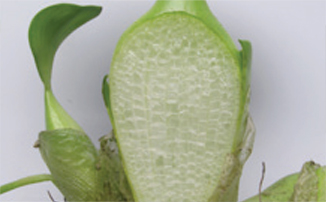
A cross-section of the water hyacinth (cut vertically)
Photo Courtesy: Yonhap News Agency
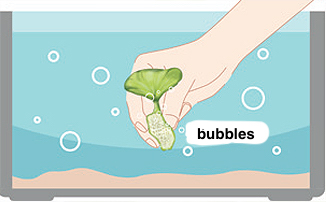
Demonstrating the squeezing of the water hyacinth in the tank (bubbles forming).