 Click here to take the quiz!
We don’t think it’s strange when fountains spray water upward or when rain falls from the sky because these are natural things. I was born in 1642, the same year that Galileo passed away, in ①  As a child, I enjoyed spending time alone and was very curious. I often thought deeply about natural phenomena and wondered, “Why does this happen?” My mother wanted me to become a farmer, but thanks to my headmaster’s persuasion, I was able to attend Cambridge University to study what I loved.
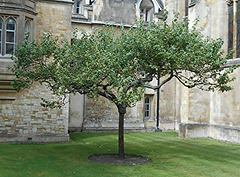
In 1665, however, the Black Death spread, forcing me to return to my hometown for two years. One day, while walking in the garden, I saw an apple fall from a tree and wondered, “Why does ② always fall downward instead of moving in another direction?” After thinking deeply, I realized that the apple falls because of a force pulling it toward the center of the Earth—gravity (also known as universal gravitation). Without this force, the apple would fly off into space. This realization led me to discover the law of gravity (also known as universal gravitation).
In 1687, I published “Principia”, explaining both the law of universal gravitation and my laws of motion. This law states that an apple falls because the Earth pulls it downward, while the Moon does not fall to Earth because of the gravitational force between them. It also explains that not only objects on Earth but also the movement of planets is governed by ③ . Who am I? ④
 As a child, I enjoyed spending time alone and was very curious. I often thought deeply about natural phenomena and wondered, “Why does this happen?” My mother wanted me to become a farmer, but thanks to my headmaster’s persuasion, I was able to attend Cambridge University to study what I loved.
In 1665, however, the Black Death spread, forcing me to return to my hometown for two years. One day, while walking in the garden, I saw an apple fall from a tree and wondered, “Why does ②
always fall downward instead of moving in another direction?” After thinking deeply, I realized that the apple falls because of a force pulling it toward the center of the Earth—gravity (also known as universal gravitation). Without this force, the apple would fly off into space. This realization led me to discover the law of gravity (also known as universal gravitation). In 1687, I published “Principia”, explaining both the law of universal gravitation and my laws of motion. This law states that an apple falls because the Earth pulls it downward, while the Moon does not fall to Earth because of the gravitational force between them. It also explains that not only objects on Earth but also the movement of planets is governed by ③
. Who am I? ④ 
④
‘s Apple TreePhoto courtesy: Loodog at wikipedia
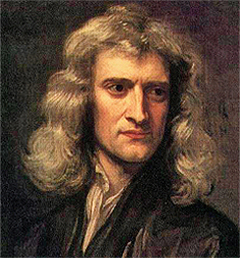
④ Portrait of
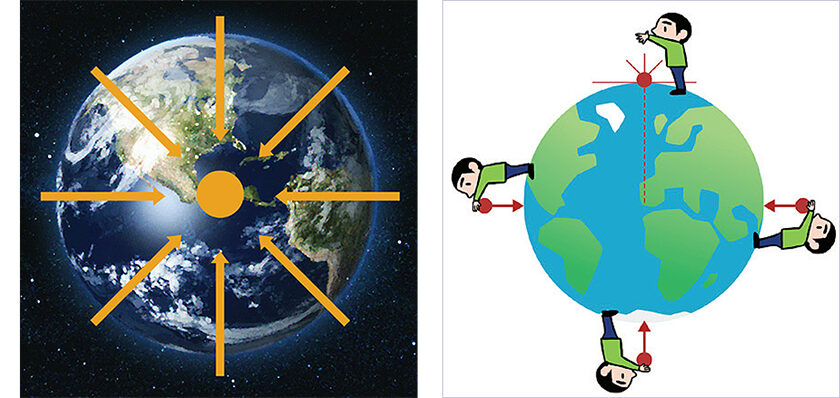
Newton’s law of gravity (also known as universal gravitation) helps predict the positions and movements of celestial bodies. The celestial bodies in our solar system follow this law. Edmond Halley used this law to predict the orbit of the ⑤ comet, estimating a 76-year cycle. Today, this law is still used to calculate the movements of space probes and satellites orbiting Earth, proving that Newton’s discoveries remain important.
comet, estimating a 76-year cycle. Today, this law is still used to calculate the movements of space probes and satellites orbiting Earth, proving that Newton’s discoveries remain important. Click here to take the quiz!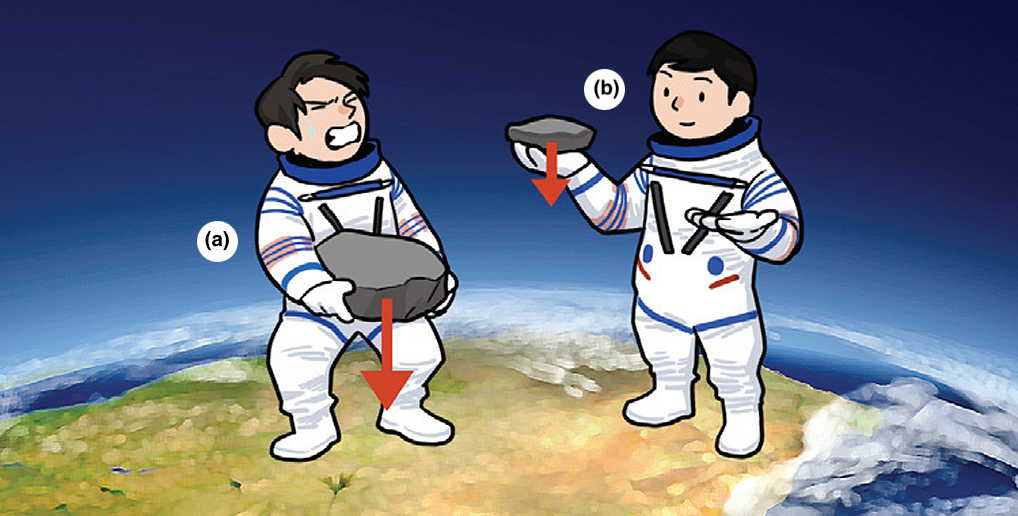
Which object appears heavier, A or B, in the image above? ⑥
A heavy stone is harder to lift than a light stone. Why does this happen? ⑦
Based on this, which stone has a lower weight, A or B? ⑧
What do we need to know the exact weight of the stone? ⑨
Give one example of measuring an object’s weight in daily life. ⑩
A heavy stone is harder to lift than a light stone. Why does this happen? ⑦
Based on this, which stone has a lower weight, A or B? ⑧
What do we need to know the exact weight of the stone? ⑨
Give one example of measuring an object’s weight in daily life. ⑩ Properties of Spring Scale
Many of the scales we use today work based on the properties of springs. A ⑪ can be used in scales because it stretches according to the applied pulling force and returns to its original length. In the image on the right, which object is the lightest and which one is the heaviest? Record your answers in the table.
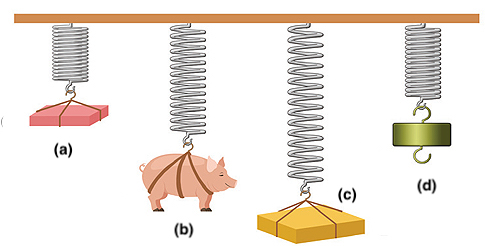
| Symbol | Reason | Earth’s Gravity | |
|---|---|---|---|
| The lightest object | ⑫ |
the spring stretches the (⑬ most, least) |
The pulling force is (⑭ small, large) |
| The heaviest object | ⑮ |
the spring stretches the (⑯ most, least) |
The pulling force is (⑰ small, large) |
| 가장 가벼운 물체 |
| 기호 |
|---|
| ⑫ |
| 이유 |
| 용수철이 가장 (⑬ 많이, 조금) 늘어나서 |
| 지구의 중력 |
| 끌어당기는 힘이 (⑭ 작다, 크다) |
| 가장 무거운 물체 | 기호 |
| ⑮ |
이유 |
| 용수철이 가장 (⑯ 많이, 조금) 늘어나서 |
지구의 중력 |
| 끌어당기는 힘이 (⑰ 작다, 크다) |
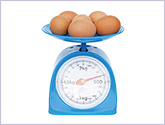
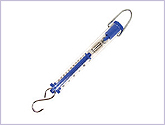
To compare the weights of two objects, a balance scale is commonly used. In addition, convenient scales such as digital scales are also widely used. Weight can be measured in grams (g), kilograms (kg), or Newtons (N), though grams and kilograms are most commonly used in daily life. In the next image, find all the scales that use springs and write down their symbols.
. ⑱
(a)
(b)
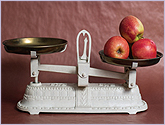
(c)
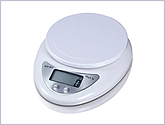
(d)
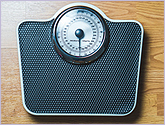
(e)
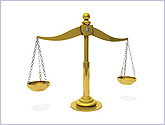
(f)
Click here to take the quiz!Weight on the Moon
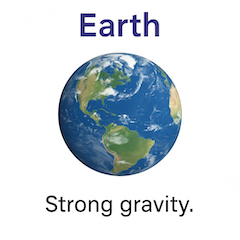
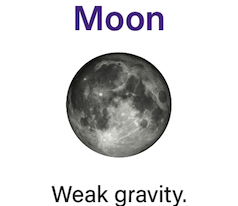
Is gravity only present on Earth? Other celestial bodies, such as the Moon, Mars, and Jupiter, also have ⑲ .
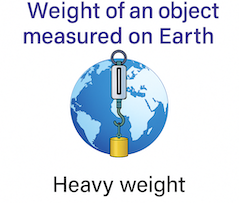
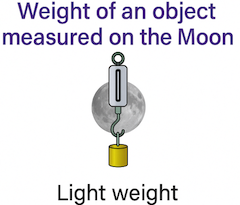
Would an object’s weight remain the same on the Moon, where gravity is weaker than on Earth? If the Moon’s gravity is one-sixth of Earth’s, what would happen to an object’s weight on the Moon? ⑳
Weight depends on the gravitational force and the location of the object.
Weight in Space
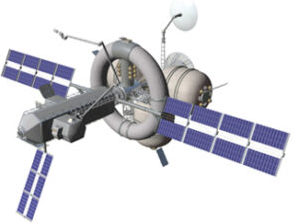
How do astronauts live in the low-gravity environment of the space station? To create a gravity environment similar to Earth’s surface, part of the spacecraft must rotate to generate ㉒ . Artificial gravity can be created using centrifugal force, which pushes objects outward when they rotate. With artificial gravity, astronauts can live on the space station much like they do on Earth.
If you lived in a space station, what would you most like to do? ㉓
. Artificial gravity can be created using centrifugal force, which pushes objects outward when they rotate. With artificial gravity, astronauts can live on the space station much like they do on Earth.
If you lived in a space station, what would you most like to do? ㉓